BLOG / PERFORMANCE
Do solar panels work in winter? What to expect in the UK
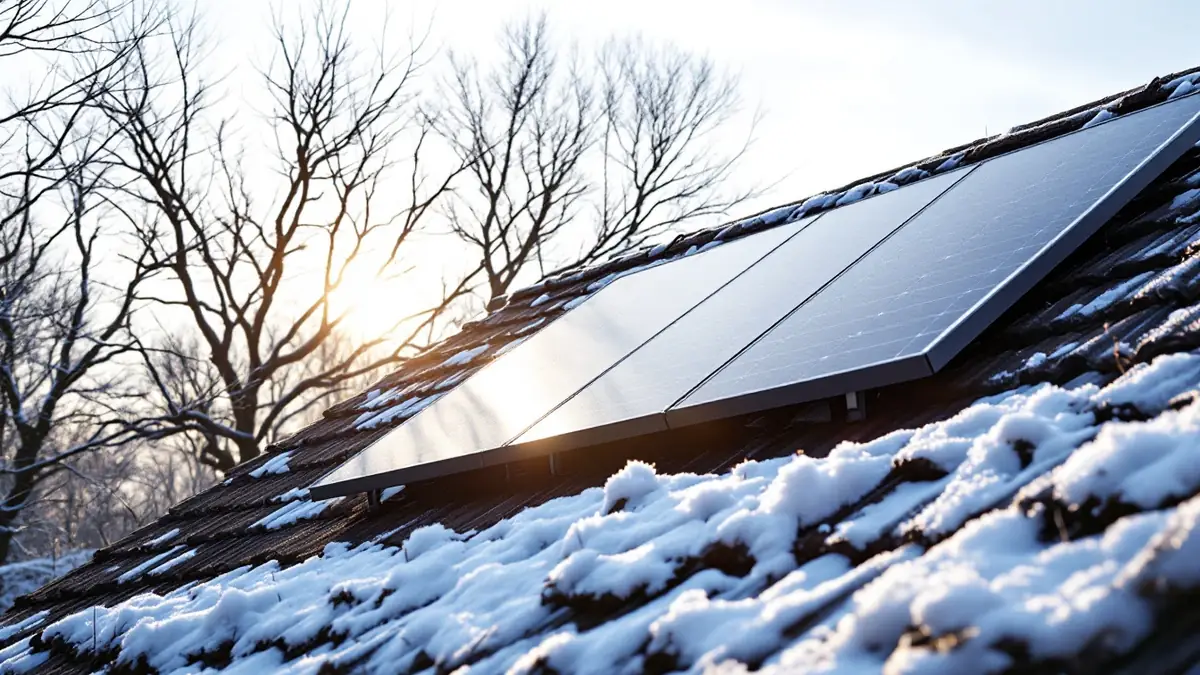
Yes, solar panels work in winter, but they make much less power. In our PVGIS runs for four northern UK cities, December output ran at one sixth to one quarter of June output. Panels need daylight, not warmth, so they still work on bright, cold days. Short days and low sun cut the total.
What the numbers show
To get real figures, we used PVGIS, the European Commission’s solar performance tool. We modelled a 1 kWp system, tilted at 35 degrees and facing south, because that is a common roof. with the default 14% system loss. The figures below are kWh per kWp.
| City | December | January | June | July | Share made in Nov to Feb |
|---|---|---|---|---|---|
| Glasgow | 19 | 24 | 110 | 111 | 13.7% |
| Aberdeen | 21 | 27 | 118 | 113 | 13.8% |
| Edinburgh | 22 | 29 | 111 | 113 | 14.9% |
| Newcastle upon Tyne | 29 | 35 | 114 | 116 | 16.3% |
Read the last column carefully. Four winter months bring only about 14 to 16% of the year’s power in these cities. However, that is a model, not a forecast, and a real year can differ.
The gap between December and June is large because of day length and sun height. In winter the sun is low and the day is short. As a result, even a perfect roof makes little.
Why output drops
Three things drive the fall. The days are shorter, the sun is lower, and cloud is more common. Because each one cuts the light that reaches the glass, the total drops fast.
Cold itself is not a problem, because panels can run a little better when cool, so the shortage is light, not heat.
Latitude matters too, since the north gets less winter light. Newcastle upon Tyne makes noticeably more in December than Glasgow does. You can see how this plays out in how solar performs in Glasgow and what to expect in Newcastle upon Tyne.
Snow, frost and low sun
Snow on the panels blocks light until it clears. Because panels slope and the glass is smooth, snow can slide off once daylight warms it. A thin frost usually burns off by mid-morning.
PVGIS includes snow in its default 14% overall loss, along with dirt, cables, inverters and ageing. Still, a snowy spell can hit one week hard.
Do not climb onto a snowy or icy roof. Instead, wait for it to clear, or ask a qualified roofer. A fall costs far more than a lost day of power. Our maintenance and cleaning guide explains safe checks.
Northern Britain and the rest of the year
The Scottish cities lose the most in winter but still do well in summer. Their June figures are close to Newcastle’s, and Aberdeen’s is slightly higher in our runs. For local detail, read about solar installers serving Aberdeen and how solar performs in Edinburgh.
So a low winter does not make solar a poor choice in the north. However, it means you should judge a system on its full year. Our PVGIS data gives about 853 kWh per kWp in Glasgow and 892 in Aberdeen, against 950 in Newcastle upon Tyne.
Does the layout change winter output?
Roof direction and tilt both play a part here. A steeper pitch suits low winter sun better than a shallow one. Shade from a nearby building also hurts more, because the sun is low.
It can. A south-facing roof gets the most from low winter sun. East and west slopes tend to give up more in winter, although they spread the power across the day. We compare them in our guide to east-west facing solar panels.
Roofs on terraces and flats raise their own questions about space and shade, so they need a separate look. For example, see solar panels on terraced houses and flats for the main points.
Should you add a battery for winter?
Many people ask this first, because bills are highest in winter.
A battery stores spare power. In winter there is little spare power to store, because panels often make less than the home uses. As a result, a battery matters less in December than in summer.
However, a battery can still help on a time-of-use tariff, when you charge it from the grid at cheaper times. That is a different benefit from solar, so check the sums. Our guide on whether solar batteries are worth it goes through it. You can also read about solar battery storage.
How to judge a quote for winter
Ask the installer for monthly estimates, because a yearly total hides the winter dip. A good estimate shows the dip in winter and the peak in summer. If the quote promises steady output all year, be wary.
Also compare the estimate with your own use. Because many homes use more power in winter, you may buy more from the grid in those months. Ofgem’s price cap for October to December 2026 averages 26.32p per kWh, according to Ofgem. Every unit your roof makes saves that rate, even in December.
For the whole process, see our page on solar panel installation. Although every home differs, you can compare options early. When you are ready, you can request quotes from MCS-certified installers. We are an independent guide, not an installer, and we contact no one without your consent.
The short version
- Panels work in winter but make far less power.
- Four winter months give about 14 to 16% of the year in our PVGIS runs.
- Judge a system on its full year and your own use.
- Stay off snowy roofs, and ask for monthly estimates.
QUESTIONS / ANSWERS
Frequently asked questions
- Do solar panels work in winter in the UK?
- Yes, but at a much lower level. In our PVGIS runs, December output ran at one sixth to one quarter of June output in four northern cities. Panels need light, not heat, so they still make power on bright, cold days.
- Do solar panels work when it snows?
- Snow on the glass blocks light, so output drops to little or nothing until it clears. Tilted panels often shed snow as the glass warms in daylight. Never climb onto a snowy roof to clear panels.
- How much power do solar panels make in December?
- In our PVGIS runs for a 1 kWp system tilted at 35 degrees facing south, December gave about 19 kWh in Glasgow, 21 in Aberdeen, 22 in Edinburgh and 29 in Newcastle. Your roof and shading will change this.
- Are solar panels worth it if winter output is low?
- Often yes, because most of the year's power comes from spring to autumn. Judge a system on its yearly output and your own use, not on one month. A quote should show both.