BLOG / PERFORMANCE
East-west facing solar panels: output, layout and when they work
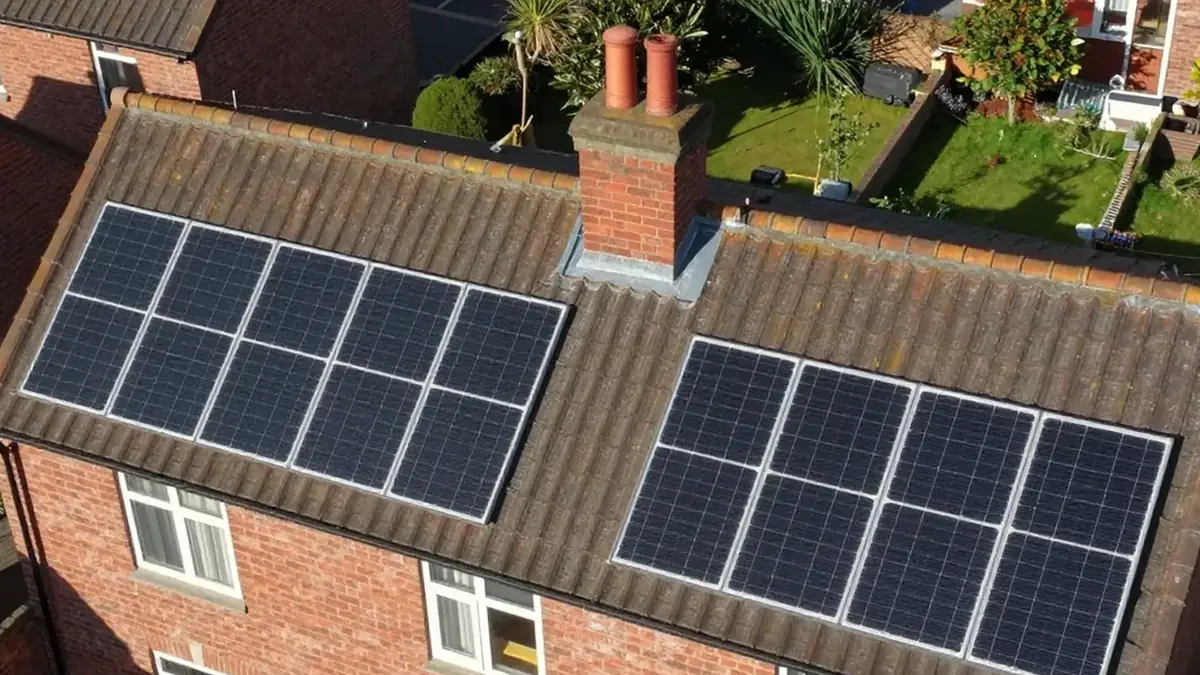
East-west solar panels make less power than south-facing ones. In our PVGIS runs for three English towns, a split roof gave about 78 to 79% of the south-facing yield. However, the power comes earlier and later in the day. That can suit homes that are busy at breakfast and in the evening.
How much less do east-west panels make?
To test this, we ran the numbers through PVGIS, the European Commission’s solar performance tool. We used a 1 kWp system, a 35 degree tilt and the default 14% system loss. We then changed only the direction the panels face, because that isolates the effect. PVGIS builds in losses from cables, inverters, dirt, snow and ageing.
| Town | South-facing (kWh a year) | East (kWh) | West (kWh) | East-west average vs south |
|---|---|---|---|---|
| Brighton and Hove | 1,156 | 889 | 904 | 78% |
| Reading | 1,021 | 819 | 798 | 79% |
| Exeter | 1,053 | 837 | 837 | 79% |
The figures are per kWp, so they scale with system size. However, they are a model, not a promise. Your shading, roof pitch and local weather will move the result.
The loss is real but smaller than many people expect, as the table shows. Because of that, a split roof is a sensible plan, not a last resort.
Why the shape of the day changes
A south-facing array peaks around midday. In contrast, an east slope peaks in the morning and a west slope peaks in the afternoon and evening. Put panels on both and the curve is wider and flatter.
That matters if you use power at the start and end of the day. For example, a household that cooks, showers and charges devices at those times may use more of its own power. Each unit used at home replaces a unit bought from the grid.
Yet the total is still lower than a south roof of the same size. So the benefit is about timing, not extra output. Check whether your own pattern of use really fits.
When east-west makes sense
These cases make a split roof worth a serious look.
- Your roof ridge runs north to south, so the slopes face east and west.
- Only one slope is large, and shading or a dormer blocks the south side.
- You want to fit as many panels as the roof allows, because both slopes are usable.
- You are home early and late, and out in the middle of the day.
On a long roof, more panels can offset a lower yield per panel, since the roof holds more of them. Our guide to how many solar panels you need explains how to size a system from usage and roof space. If you have a terrace, see our post on solar panels on terraced houses and flats.
Tilt and layout
Shade is the other big factor. A tree to the east cuts morning output, while a taller building to the west cuts the evening. Therefore, ask your surveyor to check shade on each slope separately.
Tilt matters less on an east or west slope than direction does. For example, in our runs, a flatter 15 degree tilt on an east slope gave more than the 35 degree figure. For Brighton, that was 936 kWh against 889, for Reading 847 against 819, and for Exeter 872 against 837.
Even so, you rarely get to pick the tilt, because it follows your roof. A good installer will model the real pitch and direction of each slope before they quote.
Layout also affects wiring. Many systems run one string per slope, because shade on one side does not drag down the other. Ask how the installer plans it, and whether the inverter has two inputs.
How local conditions change the result
Where you live shifts the base figure, since sunshine varies by region. Brighton and Hove has the highest yield of the towns we tested. You can read more about how solar performs in Brighton and Hove. Reading and Exeter are close behind, and you can compare solar installers serving Reading and what to expect in Exeter.
For a wider view, our output table for 24 UK cities lists the south-facing figure for each town. You can then take roughly 78 to 79% of that for an east-west roof. However, the same ratio may not hold in far northern towns, so run PVGIS for your own address.
Winter, cleaning and batteries
A split roof makes the most of long summer days. In winter, however, the sun is low, and east and west slopes tend to lose more than a south slope does. Read more in our guide on whether solar panels work in winter.
East and west slopes also collect dirt in different ways, because trees and nearby roofs differ. Our maintenance and cleaning guide covers what to check.
A battery can shift more of the midday surplus to the evening. Still, an east-west roof often has less midday surplus to shift.
What to do next
Bring your electricity bills to the survey. They show how much you use, and your installer can compare that with the daily curve of each layout. Also, say when you are home, because a model that ignores your habits can mislead.
Because layouts differ, ask each installer to quote both a south-only and a split layout where the roof allows it. Then compare the yield, the cost and how well each fits your day. Keep the PVGIS inputs the same so the comparison is fair. For the full process, see our page on solar panel installation.
Yet when you want prices, you can request quotes from MCS-certified installers. We are an independent guide, not an installer, and nothing happens without your consent.
QUESTIONS / ANSWERS
Frequently asked questions
- Do east-west solar panels work in the UK?
- Yes. In our PVGIS runs, east and west roof slopes at a 35 degree tilt made about 78 to 79% of what a south-facing roof makes in Brighton, Reading and Exeter. The power arrives earlier and later in the day.
- Is east or west better for solar panels?
- Neither wins everywhere. In our runs the two sides came out within about 2% of each other. West gives more evening power, while east gives more in the morning, so match the side to when you use power.
- Are east-west panels worth it?
- They can be, if your roof has no good south slope or you want a flatter daily curve. You need to compare yield, cost and how much of the power you use at home. A surveyor can model your roof.
- Do I need two inverters for an east-west roof?
- Not always. Many designs use one inverter with two separate inputs, one for each slope. Ask your installer how they plan to wire the two strings.